5 Tasks a One-Person Business Can Hand to AI
Contents
We ran these tests in Korean with amounts in Korean won.
This English edition is a translation: amounts stay in Korean won (KRW) as in the tests, and we did not rerun the tests in English.
Every statement about minutes saved per day is our assumption.
We did not measure how much time was actually saved.
With no staff, how far can AI help?
Picture a made-up one-person workshop called Bombyeot Calligraphy Studio, run by Eunju, who makes handwritten postcards.
Eunju does everything alone, from replying to order inquiries to packing and bookkeeping.
On many Monday mornings, Eunju is worn out by the inbox before writing a single letter.
For someone like this, we see AI as less of an employee and more of a coworker at the next desk who makes first drafts fast.

So we will follow Eunju's day and look at five tasks worth handing to AI, and where a person should look.
We actually tried three of them with made-up material.
We did not try the other two.
What about the quote request that came in this morning?
Monday, 9 a.m.
An inquiry is waiting. "For our December gathering I want 100 postcards with handwritten messages.
We need them by November 25."
We gave this inquiry and a made-up price list to two fresh AI assistants, once each, in new conversations, along with the date the inquiry arrived (Monday, November 16).
The price list: 1,200 won per card, 1,000 per card for 100 or more, a separate handwriting fee of 30,000, and production taking 10 business days after payment is confirmed.
One assistant got only "write a draft reply." The other got an addition: "Don't make up anything that is not in the list, mark it [needs confirmation], and write out how you calculated the date."
Both got the amount right: 130,000 won.
They split on the delivery date.
Suppose the payment comes in that same day and there is no public holiday in between.
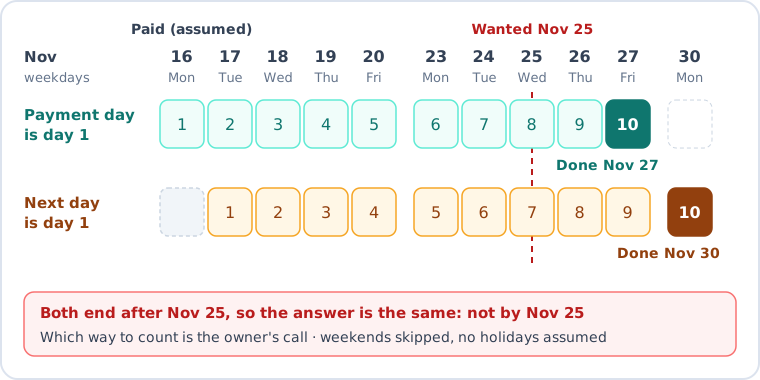
The first assistant said "production will be done on November 30." The second wrote both cases in its calculation note, "counting the payment day as day 1 gives the 27th, counting from the next day gives the 30th," and then put the earlier one, the 27th, in the draft.
Both dates are correct calculations.
The gap was not an arithmetic error: the price list never said whether to count from the payment day or the day after.
Depending on that starting day, the same "10 business days" ends one business day (three calendar days) apart.
That rule is Eunju's to set and write into the price list.
Both reached the same conclusion: "by November 25 is not possible." But the first assistant also wrote in its reply, "if your gathering is after November 30, we can make it easily." It had said it would add shipping time, and then left shipping out of that sentence.
That is why you should recalculate any sentence with a date by hand.
What about the expense notes around lunchtime?
Over lunch, Eunju opens this month's expense notes.
One shipping box has a lost receipt, one brush pen has "about" in front of the amount, and one lunch has no date.
Turning this into a table is something AI tends to do well.
We gave it seven lines of made-up notes (total 114,300 won).
The table and the total were correct.
What stood out was not the total but that it pointed out the parts we could not trust on its own.
It flagged the lunch because it had no date.
It noted that the brush pen was an "about" amount, so the total could change.
And for the box with no receipt, it said to check whether there is other proof.
It did not decide whether lunch and coffee count as business expenses, saying the notes alone could not tell.
A person's job is to match the lines it flagged against the receipts.

What about the notice and the to-do list in the afternoon?
In the afternoon, Eunju has to write the December notice.
The draft is one long block with no periods.
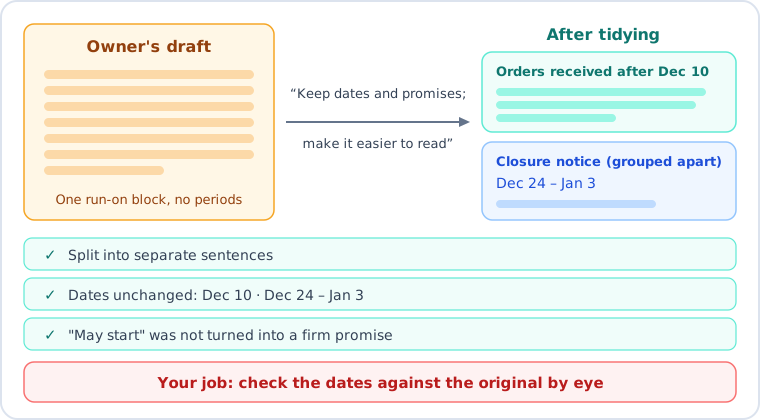
It says orders received after December 10 may start after the year end, and that the shop is closed from December 24 to January 3.
We asked: "Don't change dates or promises, just make it easier to read." The sentences were split, the closure notice was grouped on its own, and the dates stayed the same.
Wording Eunju had not made firm, like "may start," was not turned into a firm promise.
Honestly, nothing surprised us here.
Still, for a notice with several dates, check only the dates against the original by eye.
The fourth task, sorting a schedule and to-do list, is one we have not tried.
You could paste in notes and ask only for order and deadlines, but since we have no result, we will not say it works well.
We only guess that checking "does every line of the notes appear in the result?" would do it.
What about the ideas in the evening?
The fifth is sorting ideas at the end of the day.
You pour out thoughts like "what other postcards should I make next year?" and ask AI to group similar ones.
We have not tried this either.
There is no right answer, so it is hard to tell if it is wrong, and there is no "original to compare against." It is safer to use the groupings only as raw material for your own thinking.
The questions for deciding which tasks to hand over are in our 5-question checklist.
| Task | Did we try it? | Where a person should check |
|---|---|---|
| Quote reply | Yes | Recalculate the delivery date by hand, and check for promises that are not in the price list |
| Expense note cleanup | Yes | Match the lines the AI flagged against receipts, and check the total |
| Notice rewriting | Yes | Dates and numbers match the original |
| To-do planning | No | Every line of the notes appears in the result |
| Idea sorting | No | No original to compare, so use it as raw material only |
What should we not hand over?
Looking at this day, what not to hand over is clear.
Setting prices or delivery dates, and making the shop's promises such as refunds, are Eunju's decisions.
As we saw in the quote reply, AI can fill a blank with something plausible, or pick one way of calculating and stop there.
For inquiries with customers' names or contact details, check the rules of the tool you use first.
All the tests in this post used made-up material only.

What do we think?
For someone working alone, we think AI is less about judging for you and more about saving you from redoing the same work.
So when we picked tasks, we looked first at whether the place to check could be said in one line, not at how much time it saves.
We ran three kinds of tasks four times in total (the quote reply twice, the others once each), so we cannot say any one method is always better.
How to decide whether to trust a result is covered separately in how to check AI answers.
FAQ
I have no staff. Can AI take the role of an employee?
It makes drafts and cleanups quickly.
But even in our test the date calculation split, so we do not recommend handing work over like an employee without checking.
I have no time to learn this. What then?
The three tasks we actually tried (quote reply, expense notes, notice) were all done by pasting in material and adding a rule or two.
We only assume it takes a few minutes.
We did not time it.
Pick one task and try it this week.
Where should I start?
Start with something like expense notes or a notice, where you have an original and mistakes show up right away.
The questions that sort such tasks are in the 5-question checklist.
This post was written with the help of AI tools and reviewed by the site editor before publishing. How we use AI
Sources
| Content | Source | Checked |
|---|---|---|
| The made-up inquiry, price list, notes, notice and the AI assistants' results | Our own hands-on record (material we made up, no outside sources) | 2026-11-13 |
| Any other numbers or facts | None used | 2026-11-13 |