On November 12, 2026, Google unveiled a new AI model, Gemini 4 HydrogenStatement. Google introduced it as a model that brings frontier-level intelligence to everyone, and as an everyday workhorse. The same day, the model went into Google Search, and developer pricing was published too.
In one line: it is built to be faster, make things up less, and handle multi-step tasks better than the previous everyday model, Gemini 3.8 Flash. However, all the numbers come from Google's announcement (its own measurements, plus one outside index it cites) and have not been checked independently yet. Below we go through what changed, one item at a time.
Where does it sit in the Gemini 4 family?
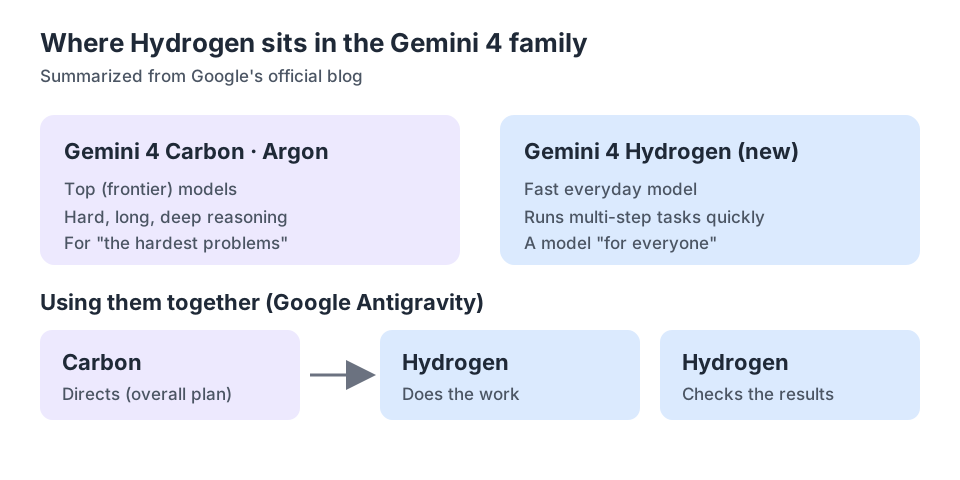
Google's newest family of models is "Gemini 4." It already included Gemini 4 Carbon and Gemini 4 Argon, which Google calls "frontier models." A frontier model is the smartest model a company has, and it is correspondingly heavy and expensive. By Google's description, they are strong at long, deep reasoning on the hardest problems Statement.
Hydrogen covers the other end. Google wrote that Hydrogen is built to run many streams of work quickly Statement. Put simply, the big models handle hard judgment, and Hydrogen handles lots of fast work. Google said that in Antigravity, its AI work tool, the two can be used together, with Carbon directing the whole job and Hydrogen doing the hands-on work and checking the results.
What changed compared with the previous model?
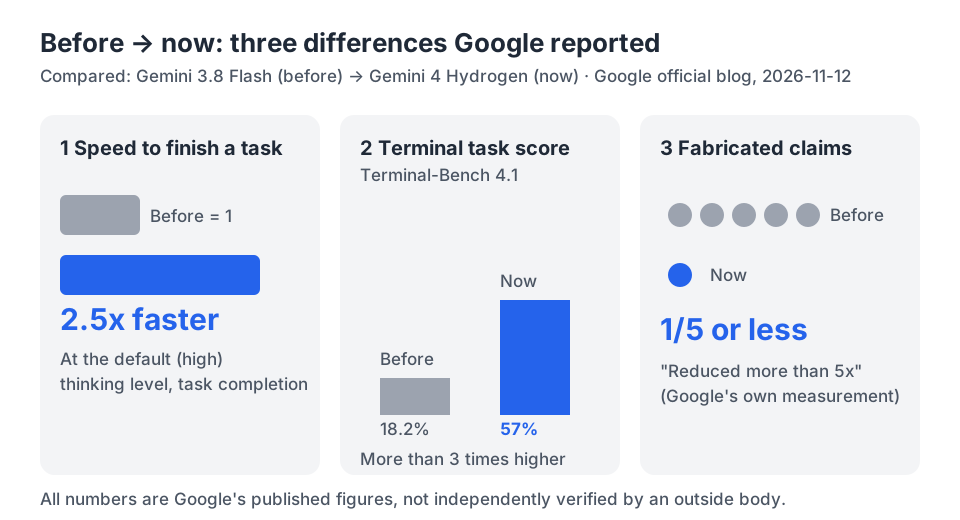
In its official blog, Google described Hydrogen as a big upgrade for teams moving from Gemini 3.8 Flash, and set its numbers side by side with 3.8 Flash Statement. Here are those numbers arranged as "before → now."
Item
Before (Gemini 3.8 Flash)
Now (Gemini 4 Hydrogen)
What it means for users
Speed to finish a task
Baseline
2.5x faster (default "high" thinking level)
Shorter waits for the same job
Terminal task score (Terminal-Bench 4.1)*
18.2%
57%
Better at chaining many computer commands
Fabricated claims
Baseline
One fifth or less (reduced more than 5x, per Google)
Fewer plausible falsehoods, but not zero
Measured by companies in early testing
Baseline
2 to 2.8x faster, 12 to 23% fewer tokens
Fewer tokens, but the unit price is double, so at current prices total cost may actually rise
Thinking levels
Not compared in this announcement
4 levels: low, medium, high (default), xhigh
You can choose fast or thorough
How much it reads at once
Not compared in this announcement
1 million tokens of input, up to 1 million tokens of output
Long documents and data can go in at once
Standard API price (per 1M tokens)
Input 0.75 / output 3.75 dollars
Input 1.50 / output 7.50 dollars
Double the unit price (3.8 Flash also rises to the same price from January 2027)
(Sources in the table at the end. Checked 2026-11-14. *In some places Google's post writes the same test as "Terminal-Bench 4.0," so we copied the version number as the official post shows it. Worked example: even if you use 23% fewer tokens, double the unit price makes the cost about 1.54 times (2 × 0.77).)
On the table alone, everything looks better, but reading it line by line gives a slightly different picture.
Speed. Before, 3.8 Flash was Google's fast model. Now, Google says Hydrogen finishes the same work 2.5 times faster. So users can expect shorter waits for answers. But this number is for the "high" level. Choosing the more thorough "xhigh" may be slower.
Multi-step work. Before, the terminal task score was 18.2%. Now it is 57%, more than three times higher. Terminal-Bench is a test of whether an AI can finish a task by entering many computer commands on its own. This kind of work is called "agentic work," where the AI does not just answer but uses tools to get the job done itself. It may also help with chained office tasks like "find the data, make a table, and put it in the sheet." But this score comes from a developer terminal test, not a separate measurement of office work.
Fabricated claims. When an AI says something wrong in a convincing way, people often call it a "hallucination." Google said it reduced this more than five times. That is welcome news, but reduced does not mean gone. You still need to check numbers, dates and sources yourself.
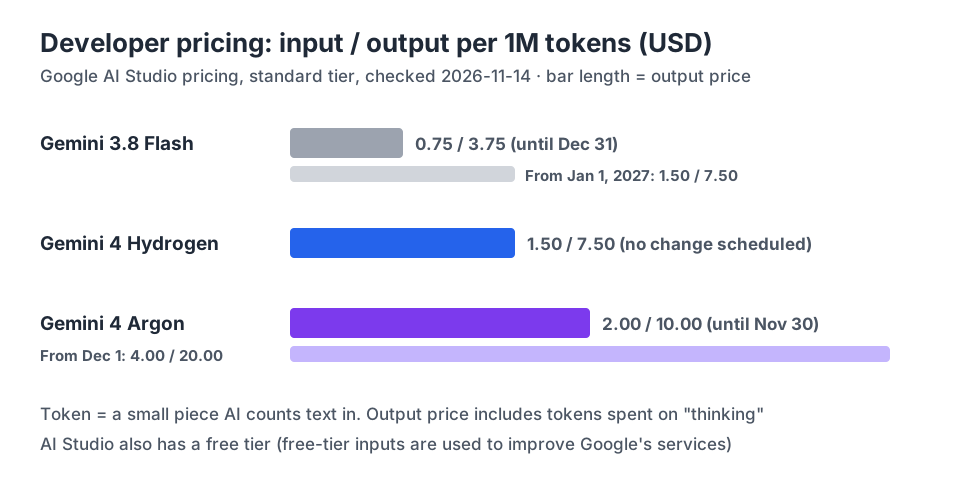
Pricing. Developer pricing actually went up. Both input and output are double 3.8 Flash's current price. But the price list also shows 3.8 Flash rising to the same 1.50 / 7.50 dollars as Hydrogen from January 1, 2027 Statement. So from next year, the choice becomes using the new model or the old one at the same price. This reading is our own calculation, not a comparison Google made.
How does Google Search change?
For ordinary users, the change in Search will likely be felt the most. Google said Hydrogen is now in Google Search for all users worldwide, and called it the biggest model upgrade in the history of Search Statement.
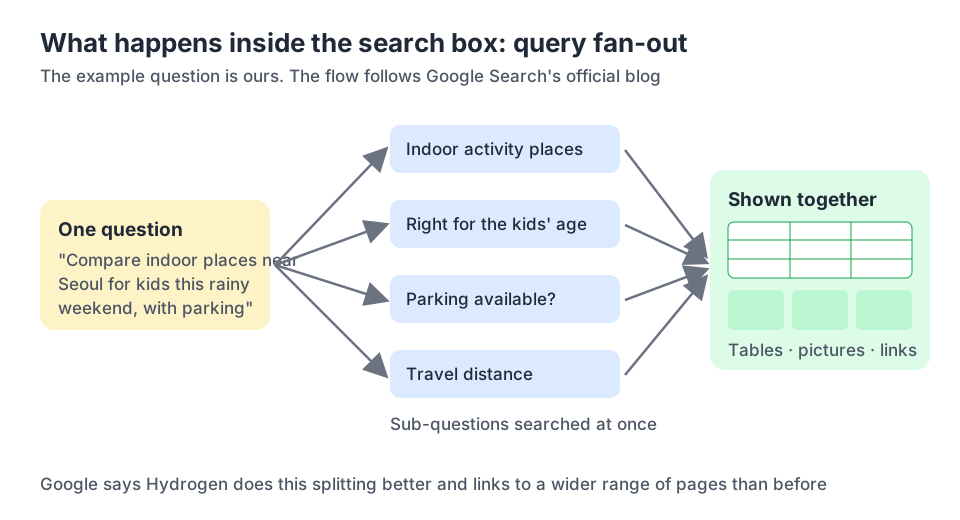
As for what changes, Google explains that Search now better understands multi-part questions, hard-to-read typos and very specific requests. The method it pointed to is "query fan-out": splitting one question into several smaller sub-questions, searching them at the same time, and combining the results. Google said Hydrogen is better at this splitting and connects you to a wider range of links than before.
The shape of answers changes too. Google said you will see more images, structured answers, comparison tables and custom tools. So users will more often see answers organized into tables and pictures instead of long text. On language, it said it gives more nuanced answers in every language AI Mode supports. But Google's Search post did not publish separate speed or accuracy numbers. And the comparison graphic in the Search post compares against "Gemini 3.5 Flash," not 3.8 Flash, so the official posts alone do not make clear which model Search was using right before Unconfirmed.
Who can use it, and where? Is it free?
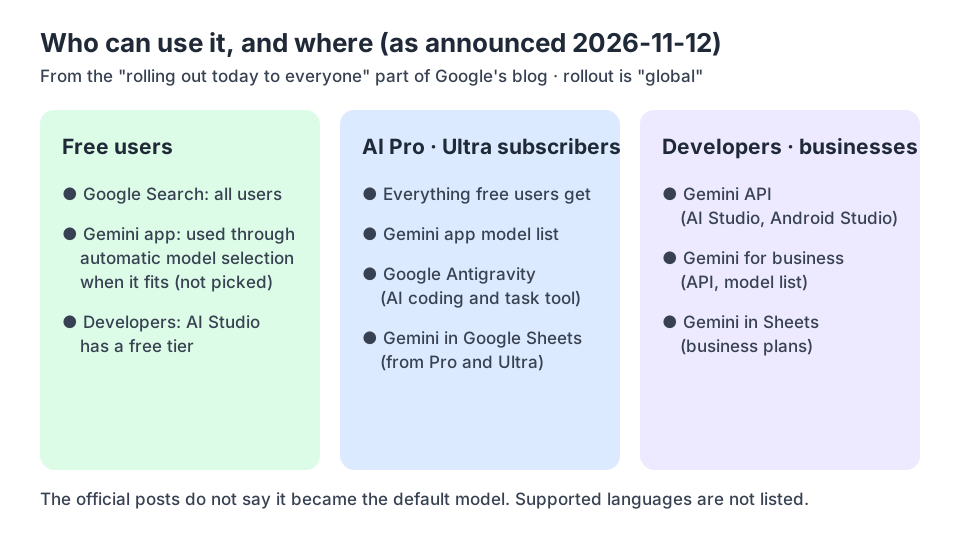
Google wrote that it is rolling out globally, starting that day, to developers, businesses and consumers Statement. By type of user:
Who
Where
Conditions
All users (including free)
Google Search
All users
Free users
Gemini app
Used through "automatic model selection" when it fits the question. Not something you pick yourself
Paid users
Gemini app model list
The official post only mentions the model dropdown
Google AI Pro and Ultra subscribers
Antigravity, Gemini in Google Sheets
Paid subscription. Sheets from Pro and Ultra
Developers
Gemini API (AI Studio, Android Studio)
Both a free tier and a paid tier
Businesses
Gemini for business, Gemini in Sheets
Depends on the business plan
A few points readers outside the US may wonder about. We are a Korea-based site, so we checked them for Korea:
Is it available in Korea: The official post only says it is global, with no country list. The Gemini help center's list of countries for plans includes South Korea for Google AI Plus, Pro and Ultra. Even so, we could not confirm ourselves whether Hydrogen is showing on Korean accounts right now Unconfirmed.
Does it work in Korean: The official posts give no full list of supported languages for this model, so Korean support is not confirmed Unconfirmed. (The Search post only says AI Mode answers better in every language it supports.)
Does it become the default model: Nowhere do the official posts say it becomes the default model. As of November 14, the Gemini app release notes did not yet show a Hydrogen entry either Unconfirmed.
What should developers look at?
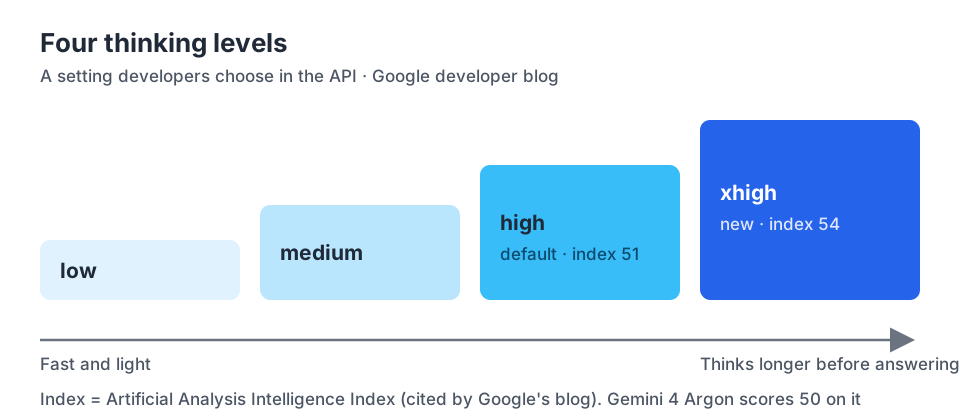
The model name in the API is gemini-4-hydrogen. There are four thinking levels: low, medium, high (the default), and a new "xhigh" Statement. The thinking level is a setting for how long the AI thinks things through before answering.
Citing the Intelligence Index from the outside evaluator Artificial Analysis, Google said Hydrogen scored 51 at the default "high," ahead of Argon (50), the model a step above it, and 54 at "xhigh" Statement. A fast model beating a higher-tier model's score is the most notable part of this announcement. But this too is a number cited in Google's blog, and we did not recheck it on the evaluator's own page.
Pricing is summarized in the figure below. Tokens are the small pieces AI counts text in, and the output price includes tokens the AI spends on "thinking."
There is one date to note. Per the price list, the standard price of Gemini 4 Argon and Carbon doubles from December 1 (input 4 dollars / output 20 dollars)Statement. It is a good moment to try moving work you run on Argon, where fast processing is enough, to Hydrogen. There is a free tier too, but the price list says free-tier inputs are used to improve Google's services and paid-tier inputs are not. That only describes whether data is used for training and improvement, so before putting in company data, check your company's data-sharing rules and contract terms first.
So what should you do now?
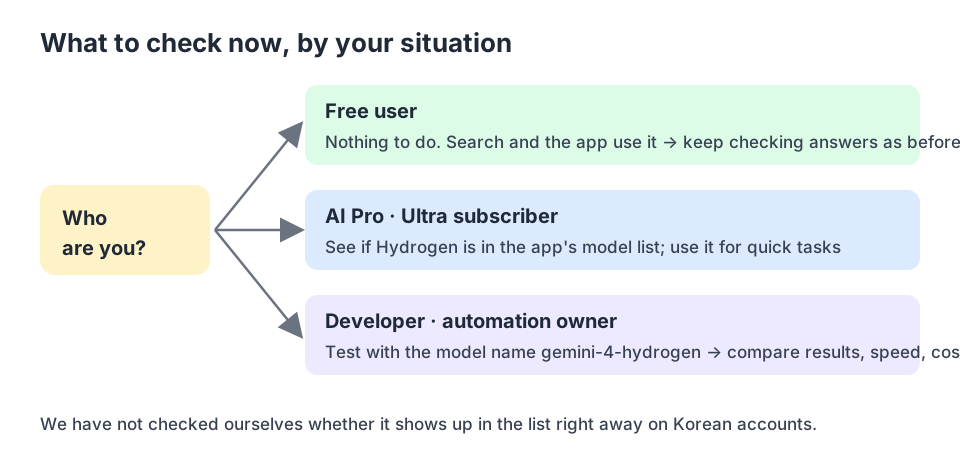
If you use it for free, there is nothing to set up. Google said it put Hydrogen in Search for all users, and that the Gemini app picks it automatically when it fits the question. That said, we have not yet confirmed when it is actually in use on Korean accounts. And do not skip checking because of the "makes things up less" claim. The more neatly an answer is laid out in a table, the less a single wrong number stands out. We cover how to check in 5 ways to check whether an AI answer is right.
If you are a paid subscriber, first see whether Hydrogen shows up in the app's model list. You can try splitting the work: tasks that need to finish fast, like sorting email or making tables, go to Hydrogen, and tasks that need long thought go to the existing higher models.
If you are a developer or in charge of work automation, the quickest check is to run a few of your current tasks with the same input, changing only the model name. Write the result quality, time taken and billed amount side by side, and whether to switch becomes clear.
Our view
From here on, this is our interpretation, not a summary of facts.
What we see as most significant in this announcement is not speed but the fact that a fast model beat a higher model's score. Until now, the common wisdom was "cheap, fast models are a bit less smart." If that gap narrows, ordinary users get better answers for free, and businesses have fewer jobs that need an expensive model. With the higher models' prices doubling in December, one could read this as Google moving users toward Hydrogen. Of course, that is our guess.
There are also gaps. Most numbers are Google's own measurements, and the official posts say nothing about Korean-language quality or the Korean launch timing. When we have results from using it on a Korean account, we will add them to this post's update history.
Frequently asked questions
Q. Can free users use Gemini 4 Hydrogen?
Yes. Google said it went into Google Search for all users, and that in the Gemini app it is used through automatic model selection when it fits the question. But nothing says free users can pick it from a list themselves.
Q. Is Gemini 3.8 Flash going away?
These official posts say nothing about retiring the previous model. The developer price list still has 3.8 Flash and only says its price rises from January 1, 2027.
Q. Is it better than Argon or Carbon?
They are for different uses. Google split Carbon and Argon for deep, long reasoning and Hydrogen for fast execution. Hydrogen beat Argon by one point on one index, but that does not mean it is better across all hard problems.
Q. Does it work well in Korean or other specific languages?
The official posts have no full list of supported languages for the model, so we could not confirm Korean or any other specific language. Google's Search post only says AI Mode gives better answers in every language it supports.
This post was written with the help of AI tools and reviewed by the site editor before publishing. How we use AI
Sources
Item
Source
Checked
Release date, model position (compared with Carbon and Argon), numbers versus 3.8 Flash, index, rollout scope, automatic selection for free users